A WITNESS by George

Death has been on my mind recently. A lot. And though Easter – the Christian celebration of Jesus Christ rising from the dead – has just passed, my mind keeps returning to death, to winter, and not to resurrection, to rebirth, to spring. Why do I feel the need to write about death, especially from inside prison?

This is my first blog post of 2015. January through March was a particularly gloomy time for me. Some of it was due to endless overcast days filled with chilly Louisiana temperatures and rain. Lots of rain. Some had to do with a prevailing feeling of loneliness. The winter was bleak.

I tried to force writing topics: New Year resolutions, finding hope in spite of being in Oakdale, blah, blah, blah – some way to launch 2015 in a positive and uplifting manner. However, all of my attempts felt Pollyanna-esque at best. So instead of veiling myself in false enthusiasm, I decided to cocoon myself in despondent introspection until my soul was ready to change seasons.

During this time, death struck. Fellow inmates, whose friendships now rank as dear as family, have lost loved ones on the outside. Aunts, grandmas, mothers have passed, carving emotional holes in my friends that are difficult to fill while incarcerated. There is no attending a wake, funeral, or burial service. Mourning or celebrating the deceased’s life in the community of loved ones is not an option. Given our current technology, it would be easier for an astronaut in the space station to be present via satellite than it would be for an inmate.

Prison is exile.

Diagnoses of cancer, diabetes, heart disease, or serious accidents are a death knell for the exiles. The haunting proclamation of mankind’s mortality cannot be ignored forever, though we all live our lives as if that bell will never toll. I’ve seen grown men collapse to their knees on the sidewalk from overwhelming grief after receiving such news from home.

Death becomes even more difficult to deal with when a fellow inmate dies of natural causes in his bunk. Life’s fragility becomes the spectre in the room who must be addressed. It is a cold, hard-hitting, unremorseful reminder to those of us locked away from our families, friends, and freedom that begs the question: could I be next?

Peter Becker died in his bunk on February 28, 2015. His sudden death highlighted the loneliness and abandonment of prison for me. For as many friends as I have made at Oakdale, and the many more that Pete had here, at the end of the day, or at any moment for that matter, it simply comes down to me and my maker. That truth is my spectre.

“He was a really good guy,” a close friend remarked in the hours after Pete’s passing. And then after a contemplative silence, “Prison is no place to die.”

I agreed on the surface. Pete was a good guy: curmudgeonly kind, loyal, charitable, good-humored with a wicked wit, and a proud father and grandpa. But “prison is no place to die” dug below that surface. It dug down into my psyche; seeping into my cocoon, feeding my gloom.

Prison is such a removal from real life that death, a reality in the free world, seems surreal here. Prison is supposed to be a place where you walk out the door after serving your time, not a place where you’re carried out in a body bag before your time. That dissonant chord struck me so profoundly that I was forced to seek a resolution to the question – why death here?

The month of March passed, and I still had no answer. Though unresolved, I am a realist. I know no one lives forever, and any breath could be one’s last. However, I felt the need to proclaim to the world, the universe, that “prison is no place to die” – for anyone! But a proclamation wasn’t what I was looking for, and proclamations from prison are not often heard.

In a moment of clarity, with Easter closing in, I realized I was seeking redemption as the answer. Pete’s redemption. More specifically, I was seeking his public redemption as a convicted felon. In a very real way Pete died twice, and I wanted to know where was his second chance – his shot at redemption?

Coming to prison is a form of death; a first death. The death of a life as one knew it. It is a painful, often times slow and very public suffocation of every aspect of life: financial, professional, personal, and familial. And in that dying, one passes from a known realm into one of the unknown – the Federal Bureau of Prisons (BOP).

Life here is an existence of bureaucratic illogic, which for those who deal with bureaucracy often, the word “illogic” is indeed redundant. To emerge from prison “rehabilitated” is to have personally tamed or exorcised the demons of one’s past in spite of the BOP staff’s best attempts to assist, or derail (depending on one’s level of cynicism), with federally mandated “re-entry” programs.

Programming boxes get checked, not because staff is concerned about the quality of the program offered or the proficiency of the inmate instructor or the inmate student, but because if boxes aren’t checked, staff get in trouble themselves by not having their supervisors check off their own personal performance boxes. BOP boxes must be checked. A checked box is the goal, not actual rehabilitation.

This is the realm, the life we live in prison, where Pete’s second death occurred. A death that was much more finite than the first metaphorical death he was subjected to by the prosecution’s path to prison. “Prison is no place to die” because the opportunity for public redemption is trumped by that death.

Where does one find the hope of spring when winter provides no glimpse of renewal?

Looking out of my cell’s window at April’s green grass and clover, the robin egg-blue sky, and feeling the sun’s warmth streaming in, I now see a ray of hope, a nod toward redemption as exampled in Pete’s incarcerated life; the life between his two deaths.

His redemption was witnessed by those of us who knew him as the man better because of his conviction to life rather than the man lessened by his conviction to prison. How I wish he could have been his own witness to the free world; that he had lived to reunite with his daughter and son, and taken his grandkids fishing – something he longed to do. He had turned the page on his past, and I witnessed a redeemed man. I’m sorry that more “outside” people – his family, friends, and the community at large – couldn’t have been a witness to that too.

Ultimately, maybe redemption isn’t a matter of how many people witness it. The fact that it was witnessed by those who were living the life alongside Pete may be evidence enough. And as a witness, maybe my testimony via this blog to those of you who have your freedom may lead you toward a path of understanding. An understanding which could shake off a winter of cold-heartedness and blossom a springtime of forgiveness and offered redemption.

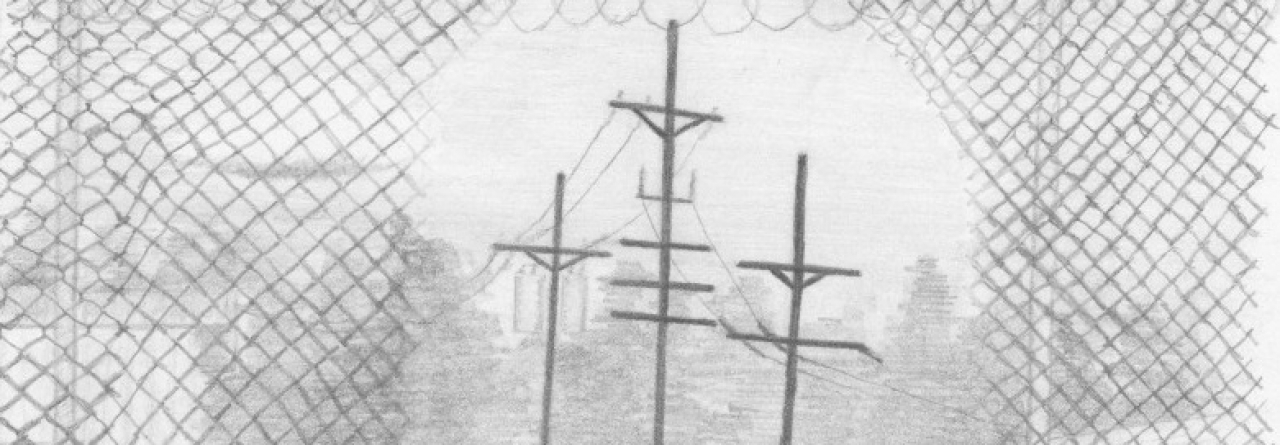
I’m looking out my window again, and the medical team is speedily pushing a trauma gurney across the compound yard toward medical. On it an unconscious inmate is frantically receiving CPR. The struggle between life and death, even on this glorious spring day, continues inside the razor wire of Oakdale, as it does every second across the globe.

I hope there are testimonies of redemption for us all. Maybe it is time to break out of our cocoons and witness. Witness the opportunity for and the power of a second chance.

[Click here to read Tony Casson’s touching witness to Peter Becker, with whom Tony shared a cell while at Oakdale FCI.]

A Note From Tony: I was happy to wake up this morning and see this post by George from Oakdale FCI. George writes them and mails them to my ‘other’ Diane (still the original and best!), who types them and posts them for me (us).

Even when individuals are attempting to be constructive and live redemptive, introspective, and productive lives, our government, in its infinite wisdom, does not allow interaction between men in prison and those on supervised release.  I am grateful to Diane for her continuing support of those who are incarcerated, and of yours truly.

This post, while beautifully written and profoundly touching in its honesty, definitely shows a negative side to prison life which I would like to address. As Diane S. (my new, OTHER Diane!) struggles with adjusting to being an inmate’s wife, she cannot be shielded from the fact that these emotions do exist inside the confines of the prison environment.

That is not to say that life there is always mournful, morose, or melancholy, but it certainly can be a difficult place at times. There are times of laughter as well, and it is the rare individual who spends their entire time in prison living in a world of sadness, depression, or negativity. I know that George is, by nature, an upbeat and positive person, and from what Diane S. has written, so is her husband Chris. These men will deal with the ups and downs of prison life but will create more ups than downs.

I hope they find each other and get to know each other. George lives in my old housing unit, Allen.

George, thanks for writing so well. You honor these pages. Diane #1, you ARE still #1, and Diane S., you have my utmost respect and admiration.

LETTERS TO HEAVEN: In Memory Of Peter Becker

LETTERS TO HEAVEN:
In Loving Memory Of Peter Becker

Dear God,

It has been a long, long time since I have had the opportunity – indeed, the ability – to sit down in front of a keyboard and write to you. That ability has now been granted, and I cannot thank you enough for Your part in making this possible. Your presence in my life is evident on a daily basis and I am truly humbled by the blessings I have received. As the creative cobwebs clear and my fingers begin to loosen up, I pray that the words which ultimately find their way to these pages will be deemed worthy of being read by those who take the time to do so.

For those reading this who are not familiar with certain aspects of my story, I will provide a little background: My access to a computer had been denied me since my release from prison on May 20, 2014 due to the restrictions imposed upon me by the federal court I was sentenced in before I began my incarceration at Oakdale FCI in 2010. Although my supervision was transferred to Washington, D.C. upon my release, the jurisdiction for the case itself remained in south Florida, where I was sentenced. That jurisdiction has been recently transferred to Washington, D.C. and along with the transfer came a modification allowing me the ability to use a computer and access the internet which will allow me to pursue writing once again as a way of reaching out to others. Although the anticipation of sitting down to write has been high, never in my wildest dreams did I imagine that feelings of deep, deep sadness would be mixed in with the joy of having access to a computer again.

The sadness is attributable to news I received recently about the death of my friend Peter Becker. “Pete” died in late February from an apparent heart attack. He was my ‘cellie’ for most of my incarceration at Oakdale, and the news of his death struck me an almost palpable blow. Lord, I was extremely fortunate that I had learned to turn to you first when confronted with trials, tribulations, tragedy, or – as in this case – extreme and profound sadness.

Help me find words now, Father, which adequately paint an accurate picture of the relationships that can evolve in prison. Without Your help, how can I ever effectively describe the dependence that often develops between 2 people who share a 7’ x 11’ living space separated from family and friends? Between men who are required to face the societal consequences for what are usually, first and foremost, sins against You? Between individuals who are compelled to posture themselves as tough and impenetrable, but in reality are frequently vulnerable individuals who are prone to introspection which can often lead to feelings of inadequacy, failure and hopelessness?

There is an intimacy of thought and action which ultimately envelops those who occupy a space of that size which is capable of rivaling that of the closest of married couples. For example, in the case of Pete and myself, we shared much about our respective families; our children, ex-spouses, grandchildren. I grew to know Pete’s family and came to consider myself a part of it in a way I cannot explain. For over 3 ½ years, I saw pictures of his children displayed on the inside of his locker door. I was ‘there’ for the birth of his two grandchildren and ‘watched’ them grow along with Pete till the day I walked out the door. And on a daily basis, I listened in as Pete talked to, and fawned over, the 2 little ones. Sometimes it was funny to hear the way he spoke to them as if they could hear him. More often than not, sadness tugged at my heart as I detected the longing in his voice for the sound of their laughter and the warmth of their hugs.

Pete’s daughter, her husband, and the 2 children came to visit Pete once before I was released and there was unmistakable joy radiating from his face upon his return to our cell. He described holding them and told me about their loving reactions to meeting him for the first time. To the best of my knowledge, that was, sadly, the last time he would hold his grandchildren, hug his daughter, or see his son-in-law face to face. It was as if You knew he would be coming home to You, Lord, and that visit was arranged so that Pete’s daughter would always have a reference point when talking with the children about their Grandfather. During that visit, several pictures were taken. Undoubtedly, those photos will become cherished items to Pete’s daughter and to her children as they grow older. For what would prove to be the brief remainder of his life, they would also serve to remind Pete what his two little grandchildren sounded like, what they smelled like, and what it felt like to hold them in his arms. Pete had a son as well, and his picture was also included in the gallery of love on Pete’s locker door.

Watching all of this was wonderfully awkward, and painfully joyful, and if there seems to be contradiction in those words, it is because prison is full of contradictions.

When I left Peter, he was a big man. As many men who are incarcerated are prone to do, Pete gained considerable weight after beginning to serve his own sentence, but this big man was a teddy bear, and he had a big heart. Perhaps the additional weight put a strain on his heart that ultimately proved to be too much, but while his heart beat, it was a heart full of love for many people even if articulating that love for others outside the circle of his family was difficult for him. It is that way for many people in prison, Lord, as you know. Living in an atmosphere full of ‘A’ personalities and overflowing with testosterone, exhibiting sentiments and emotions like love, softness, kindness, caring and compassion are likely to be misconstrued as a sign of weakness, and many are reluctant to appear weak in prison for reasons that should be obvious.

Pete had already been at Oakdale for some months when I first arrived. His sentence was 15 years, but 10 of those years were added on as an ‘enhancement’ due to a previous offense. However, as we learned a couple of years ago, the enhancement clearly was applied inappropriately and should never have been added to his 5 year sentence for the current offense. I will never defend the actions of myself or any other person who commits crimes against society or sins against You, Lord, but the rules of our judicial system should be applied fairly and in this instance an error was obviously made and should have been corrected. Unfortunately, the objection was apparently not raised in a timely manner and while Pete had high expectations his argument for a sentence reduction would prevail, I learned he found out late last year that his appeal had been denied and there was no further recourse. His sentence would stand and that meant his grandchildren would not see their Grandfather in freedom for another 6 or 7 years.

Only You know, Lord, what conversations Peter had with You after his pleas for fairness were denied. Perhaps he was tired, sad, or experiencing feelings of hopelessness. I had also heard he had lost his job in the prison laundry, which had been the center of his prison life, and now his hopes for justice and the freedom that would have enabled him to see his grandchildren grow up had been dashed. Maybe he lost his will to live and prayed to be brought home to You, Lord. Only You know.

I am certain the suddenness of Peter’s death stunned everyone at Oakdale, particularly those who were close to him. I can only pray, Father, that those who mourned his passing turned to You for comfort in their time of need. The bonds created between men who have squandered their freedom can be as strong as any experienced while living outside the razor wire. People learn to rely upon each other, to lean on each other, to trust and, yes, love one another. The harsh reality that death can claim us before having the opportunity to regain the freedom we once failed to use properly and make efforts to redeem ourselves in the eyes of society is something that is visited upon incarcerated individuals at one time or another during the course of each person’s sentence. People do die everywhere there are people, of course, and prisons are no exception, but how death affects the average person is different in prison. Each of us who has been in that situation is suddenly faced with the realization that we, too, might meet the same fate as those we have known who have died while serving their sentences. There is something cold and decidedly impersonal about dying there. Most people don’t really understand what, exactly, goes on behind the walls and razor wire of institutions they may pass by, but it is not complicated really: Life goes on and, where there is life, there is also death.

The news of her father’s sudden death must have rocked Pete’s daughter back on her heels. I have no certain knowledge of how news of that sort is delivered to the family of the inmate, but I suspect it is done with a phone call. I pray that was not the case, Lord, but I cannot imagine it being any different. After all, an inmate dying while incarcerated simply means a bed has opened up. Dealing with the details of death is not the primary concern. Death is simply an inconvenience that must be dealt with: Notifying the next of kin; gathering up the belongings; designating another individual to occupy the space once filled with someone’s father, someone’s grandfather, and someone’s friend.

Pete did not talk as much about his son as he did his daughter, but I know he loved him and I am certain that he, too, was as shocked as his sister to learn about his father’s death. I pray they both turned immediately to You, Lord, and I would ask anyone reading these words to pray for them. I would also ask that You give comfort to all who knew Peter and loved him. While I am fortunate to have been released from prison myself, I do wish I could hug those who I spent time with in Oakdale and who I know will be reeling from Pete’s death for some time to come. Perhaps you can reach in and squeeze their hearts for me, Father, and let them know they are all loved.

As for Peter, I give thanks that he is with You, Lord, and that his anguish over his separation from his family is over.

And for all of those in the ‘free world’ who may read these words, I pray that each and every one of you uses your freedom well, “For you have been called to live in freedom, my brothers and sisters. But don’t use your freedom to satisfy your sinful nature. Instead, use your freedom to serve one another in love.” (Galatians 5:13 NLT)

When we use our freedom to satisfy our sinful nature, we run the risk of finding ourselves deprived of our freedom, our families, and our friends. When we fail to recognize the importance of using our freedom the way You intended us to, Lord, we also run the risk of leaving this life before regaining an opportunity to get it right.

And prison is a terrible place to die.

Peter Becker, you will be missed, my friend. It was an honor to know you and to share cell #208 at Oakdale FCI with you. Thank you for allowing me to witness the expression of the love you had for your family.

Until we meet in heaven, I love you Pete.